

RKT Products Are Popular in Ujjain: Shailendra Jain
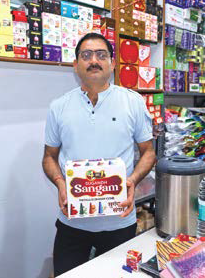
Ujjain, the land of Mahakal, attracs pilgrims and tourists from across India and around the world. Consequently, it has a huge market for agarbatti, dhoop and pooja materials. Alongside strong demand for premium products from Ahmedabad and Bengaluru, products from local manufacturers also sell in large volumes. Mr Shailendra Jain has been handling the distribution of several branded companies and operating retail outlets through his firm, HR Sales, in Ujjain for the past 20 years. In a conversation with Sugandh India, he said that his retail shop is named Shree Sugandh Vaibhav, a name he chose at the suggestion of his Guruji. Through HR Sales, he trades in agarbatti and dhoop products throughout Ujjain. He explained that he started with the agency for Man Mandir Ganga Products, an opportunity he received through Mr Arun, who is a Super Stockist based in Indore. He added that he had also worked under him for seven years, and they were the ones who offered him the Man Mandir brand agency.
HR Sales currently handles seven to eight branded companies, including RKT, whose products he has been dealing in for the past eight to ten years. He said that he has also met Bharat Bhai, and the company’s sales team visits regularly, allowing them to meet frequently. He added that some of their products are very good. RKT’s Panch, Sugandh Sangam Metallic Cone and dry sticks sell particularly well. Besides these, he also sells agarbatti boxes priced at 3₹10 and 3₹20. He explained that RKT is very popular here and that he handles the company’s distribution exclusively in Ujjain. Speaking about his relationship with the company, he said that its people are very helpful and immediately resolve any problems he faces. He added that he currently also distributes Sachche Sai, Parimal Mandir, Sujata, Dev Darshan, Jain Products Ratlam, Amrutha Sugandh and Nagpur Safal Industries and Ahmedabad-based Kalpana and Lohana Industries. His retail shop also sells products from several branded companies, including Balaji, Big Bell and Misbah. He stocks leading dhoop and agarbatti products from across the country at his outlets.
In response to a question from Sugandh India, Mr Shailendra explained that Ujjain has a very good market for agarbatti, and they deal in premium-quality products at selected outlets. Customers from outside Ujjain also visit personally to buy products. His network extends to more than 120 outlets. Answering another question, he said that Ujjain is a religious city with high consumption of agarbatti. Similarly, a large number of pilgrims and tourists visiting the city prefer premium-quality products. Nowadays, people increasingly prefer premium- and medium-quality products.
When asked about the differences between the Ujjain and Indore markets, Mr Shailendra explained that consumer preferences and purchasing volumes differ from place to place. Some products sell very well in Indore, while others perform better in Ujjain. Consumers have different tastes in different markets, and their purchasing power also varies. However, outside brands perform well in both cities, and local products also enjoy good demand. He added that packs of half a kilogram and one kilogram priced at ₹100 are also in good demand.
Mr Shailendra told Sugandh India that customers here focus on both quality and quantity. Zipper packs priced at ₹50 and ₹100 sell the most. Jumbo packs weighing 200g and 400g, priced at ₹100 and also known as family packs, are increasingly popular. Overall, the agarbatti and dhoop market has been growing rapidly here. Products with MRPs of ₹10, ₹20, ₹50 and ₹100 generally enjoy the highest demand. Answering another question, he said that Balaji, Lohana, RKT and Jain Products are among the leading brands in Ujjain’s agarbatti market. He explained that demand for bamboo-less products has increased. Larger packs of dry dhoop, cones and cups are gaining popularity. Consumers prefer premium ranges in wet dhoop. Big Bell, Grah Shanti and Balaji perform well in this category. He also handles Oswal Miracle’s dhoop sticks. Mixed varieties and larger packs of sambrani cups containing 30–40 pieces sell particularly well. In the best-quality segment, Cycle’s Naivedya is very popular.
In response to another question from Sugandh India, he explained that established outside brands enjoy strong demand here. Products from Ahmedabad-based brands such as Nishan, Shreeji and Lohana sell well. Bengaluru has traditionally remained a leading source for the premium market, and its products enjoy good demand. Hem and Parimal Mandir’s Bharatvasi also have a good market. He added that Saraswati and Mangalam are the leading camphor brands here. Locally produced camphor also has a good market. In Chandan Tika, Dev Darshan, Safal, Kashi, Shree Ganga and Labh Ganga’s Ashtgandh sell well. Several local manufacturers of Chandan Tika in Ujjain also have a market. Divya Shakti performs well in pooja oil. He said that a middle-class customer in Ujjain typically spends around ₹100 per month, while customers buying premium products spend between ₹500 and ₹1,000 monthly. Answering a question about brand loyalty, he said that he has been in the agarbatti business for 15–20 years, but around 95% of customers purchase products based on his recommendations. Only 5% come asking for specific brands by name.
Responding to a question about the impact of the war on business, Mr Jain said that the market has slowed down somewhat. Prices of all products have increased, including agarbatti and dhoop. Freight costs have also risen, forcing everyone to reduce their margins. Companies have also reduced product weights and quantities. With prices increasing, everyone is facing some losses. When asked what advice he would give to new companies entering the market, Mr Jain said that premium quality is the most important factor. He added that he can sell any company’s products if they offer the best quality. For a new product to succeed in the market, quality is essential. If he recommends a new packet to a customer and the customer does not like it, they will refuse to buy it again. This also damages his reputation. However, if the product is good, it helps build customer trust.


