
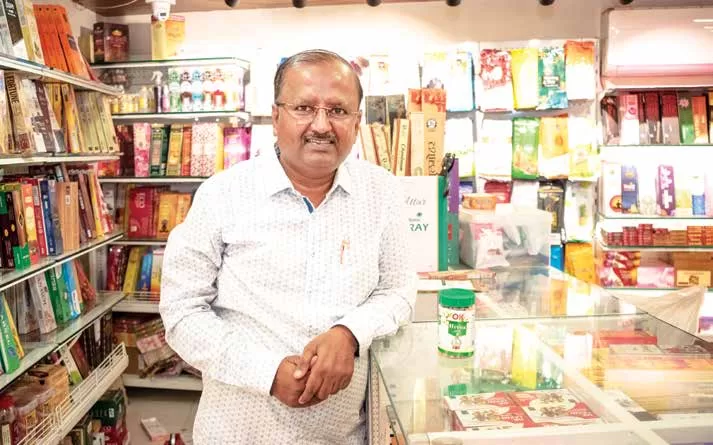
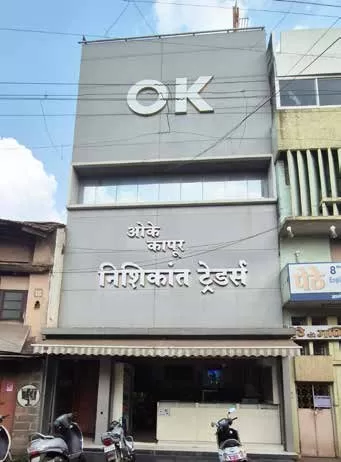
Nishikant Traders: Powering Maharashtra’s Incense Market“Good Camphor Leaves Nothing Behind”: Rahul Halade
He informed that raw materials forcamphor come from Indonesia andChina. About 4–5 companies, suchas Saptagiri Camphor Company,process these into camphor powder, which isthen blended with other materials to maketablets and other products.
In response to a question about why Kolhapurand Sangli have become hubs for camphorproduction, he said the region has had a longstandingtradition of high camphor consumption.As demand grew, local production increased.
Alongside manufacturing the popular OK brandof camphor, Nishikant Traders also producesincense sticks, dhoop, and dry sticks. Additionally,they are super stockists for well-known brands suchas Hem, Moksh, Nishan, Jesal, Dhanlaxmi, andUtsav Fragrances, and distributors for over 30 otheragarbatti and dhoop manufacturers including Balajiin the Kolhapur region.
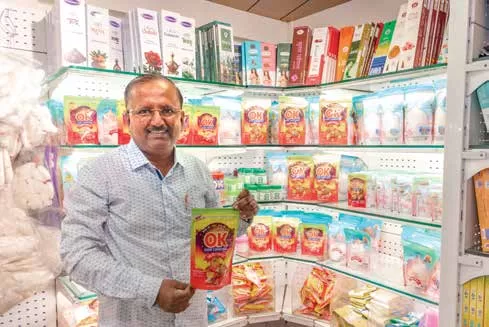
The hallmark of a good camphor isthat it burns completely, leaving noresidue behind. That is considered thesign of pure camphor. RahulBabasaheb Halade, the head of OKCamphor manufactured in Kolhapur,shared in a conversation withSugandh India that aside from thefact that pure camphor burnscompletely, the belief that purecamphor doesn’t emit black smoke isa misconception. Camphor does emitsmoke while burning.
Rahul Halade, in response to a question fromSugandh India, stated that production of OKCamphor began in 1967 with his father, Mr.Babasaheb Halade. Initially, they operated from home,but as business grew, they established a factory. Today,OK Camphor offers nearly 100 packaging varieties, withtablet sizes and pack formats ranging from ₹1 to ₹1000.The company also produces Bhimseni camphor.
OK Camphor is not only sold in Maharashtra butalso in Karnataka, Gujarat, Tamil Nadu, Kerala,Rajasthan, and other states. Kolhapur and Sangli havenow become hubs for both production and consumptionof camphor, widely used in rituals and havans acrossIndia. Recently, camphor with added fragrance for usein electric burners has also become popular. Thedemand for camphor has surged post-COVID, especiallyfor scented variants. This increasing market interest hasprompted major companies to enter the camphorsegment. OK too is planning to scale up production andintroduce new fragrance-based camphor products.
Apart from camphor, Nishikant Traders is a well-knownname in Maharashtra—especially Kolhapur—asa super stockist and distributor of branded products.Speaking on how they entered incense and dhooptrading, Rahul said that 8–10 years after camphorproduction began, they ventured into incense trading,starting with Hem Agarbatti as their first distributionpartner. Today, Nishikant Traders handles many majorbrands including Balaji, Nishan, Dhanlaxmi, Moksh,Jesal, Utsav, Karnataka Fragrance, Bansi, Manohar,Goodluck, Amrutha, Somnath, Real, Parimal Mandir,Anubhav, AS, Zebra, Satya, Pandian, Krishnakala,Haria, D. Shankar, Deshpande, Tathe, Shreejee,Gajanan, and TPRG. As a super stockist, their networkspans across Kolhapur and Western Maharashtra,Konkan, and Goa, connecting to nearly 4,000distributors and retail counters.
On the Kolhapur market, he mentioned that incensestick sales are strong and growing rapidly. Zipper packsweighing 100–120 grams and priced between ₹50–₹60are top sellers. Regarding the Goa market, he said it ismainly driven by economy products priced at ₹10, butdue to foreign tourists, there is demand for premiumproducts as well.
He noted that in Kolhapur, demand for dhoop isrising, though incense still dominates with 70% marketshare. Dhoop holds 30%, evenly split between wet anddry varieties. In wet dhoop, zipper packs are mostpopular. Brands like Nishan (zipper pack) and Real(premium) have strong demand, along with Balaji andKrishna Kala by A Ravi Raag. Packs priced at ₹20 and₹50 are most in demand. A Ravi Raag’s premium wetdhoop also performs well.
Balaji’s premium incense sticks are top-sellers, withsmall packs at ₹50 and large packs going up to ₹2000.The dry stick segment is also expanding, with ₹50 packsleading in popularity. During festivals, Panchjanya,Balaji, and Good Luck’s Chintan Sambranicups sell well. In Sambrani sticks,Pandian’s Mahalaxmi, TPRG’s Tapasya,and OK’s own products are in highdemand.
Responding to a question about pujaoils, he said that Cycle was the pioneer inKolhapur, and now both Cycle and OK arepopular. In camphor, OK holds the No. 1position, followed by Mangalam. Insandalwood tilak, Manohar’sAshwagandha variant is in demand. Inattars and roll-ons, SRS and Kelkar brandsare top choices.
He concluded by stating that theaverage monthly purchase by a customer isaround ₹200, but premium customers mayspend up to ₹5000. About 5 out of 10customers make theirpurchase decisionsbased on brand names.
Venue : Mumbai
Date 12th and 13th April 2025


