
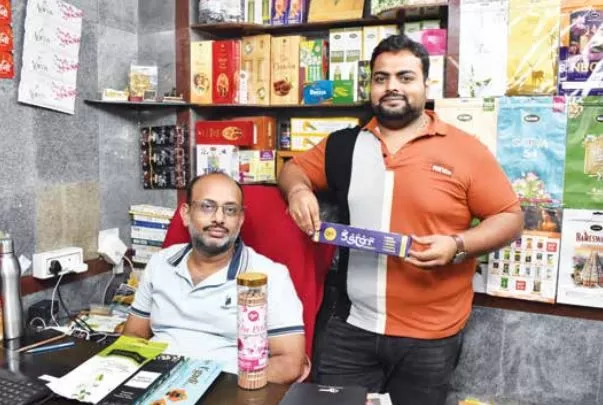
While demand for bamboo-less products like wet dhoop and dry sticks is rapidly growing in North Indian states, Kolkata still has a 90% incense stick market, with only 10% accounted for by dry sticks and sambrani cups. Rajiv Jha, head of Mangaldeep Trading Firm, which has been in the incense trading business for over five decades, told Sugandh India that the Bengali community still strongly prefers incense sticks. Demand for bamboo-less products mainly comes from people who have migrated here from Bihar, Uttar Pradesh, or North India.
Responding to Sugandh India, He said that Jain communities used bamboo-less products long ago, but now due to concerns over burning bamboo, people from other communities are also becoming hesitant. His father started incense trading in 1972. Later, they set up an office in Kolkata from where they supply all of South Bengal. His brother manages North Bengal operations under the name Bandana Agency in Siliguri.
Their firm’s first agency was Sugandh Shringar, followed by Charu Perfumery. Today, they hold agencies of 16–17 incense companies including Amrutha, Jaipur’s Bansi, Hyderabad’s Maratha Darbar, Delta, Savitri, Vasant, and several Bengaluru brands. From their Kolkata office, they supply South Bengal, while his brother handles north Bengal markets across the Farakka Bridge from Siliguri office.
Earlier they supplied Bihar, Odisha, Assam, and Jharkhand, but due to rising transportation costs, they have stopped.
Mr. Jha said they also supply to Bangladesh, where Amrutha’s incense is extremely popular. Bamboo-less products have no market in Bangladesh.
In Kolkata, the top-selling incense brands include Cycle, Shalimar, Amrutha, Rhythm, Parimal Mandir’s Shantiniketan, Balaji, Darshan, Zed Black, Shakuntala, and ITC’s Anushree.
He said incense sticks still hold 90% of the market. Wet dhoop and dry sticks are more popular among non-Bengali communities. With strong social media promotion of bambooless products, he expects their market to grow to 20–25% in the next 10 years.
Regarding pricing, he said ₹50 incense packs are the most popular in Kolkata—both zipper and long boxes. They offer good quality and quantity. Productspriced at ₹20–₹25 also sell, but ₹50 packs dominate in volume.
In wet dhoop, Zed Black and Rocket sell the most. Sambrani cups are growing fast, with strong sales of Delta, Savitri, and Satvik, mostly in jar packs.
He said chandan(sandal) tika has a small market, as Bengali families traditionally prepare sandal paste manually. Similarly, attar and roll-ons don’t sell much; they are used mostly in Muslim areas and usually lowpriced ones. Although Balaji’s premium roll-on is excellent, it has limited demand. Perfume and attar are separate markets from incense.
A wealthy customer might buy incense worth ₹400–₹500, but common households typically spend only ₹60–₹70 per month. There is some brand loyalty, but only 5 out of 10 customers ask for products by name; most simply ask for “something good.” Only companies maintaining consistent quality over 40–50 years remain strong.
Venue : Mumbai
Date 12th and 13th April 2025


