



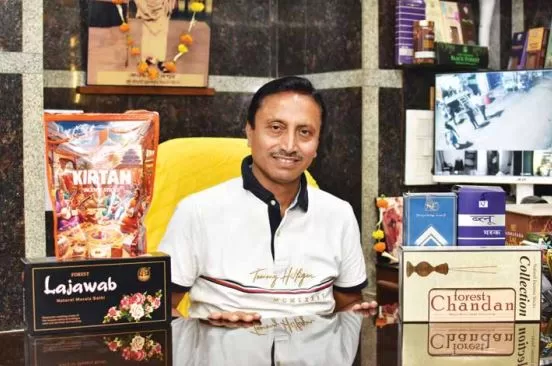
Consistent Market Presence Helps Brands Succeed in Bengal:Mintu Chaudhary, Sree Guru Perfumery Works
With roots in the agarbatti trade going back over four decades, Sree Guru Perfumery Works is a well-known name in the West Bengal incense market. Headed by Mr. Mintu Chaudhary, the company has grown from a local trading operation into a strong agency business with wide reach across West Bengal. In an exclusive interview with Sugandh India, Mr. Chaudhary discussed the company’s journey, distributor network, and changing trends in agarbatti and dhoop consumption.
Recalling his early days. Mr. Mintu Chaudhary shared that the first was started in Kolkata by his father in 1978. He himself joined the business 2–4 years before his father’s demise in 2000, and after that, he fully took over the operations. Initially, the family was engaged in local agarbatti trading, after which they expanded to sourcing products from Bengaluru. Over time, Mr. Chaudhary shifted focus to running an agency business, with the aim of strengthening and expanding the company’s name in the market.
Talking about his agency journey, he said that his first agency was Parimal Mandir, followed by Shakunthala Agarbatti. Over the years, his portfolio expanded to include brands such as Forest, Karnataka Fragrance, Zebra, Jesal, and AR Industries, among others. At present, he handles products from around 3–4 companies, covering nearly 100–200 brand variants across different categories.
On the geographical spread of his business, Mr. Chaudhary stated that his network is concentrated in West Bengal and Bangladesh, with no presence in other Indian states. Within West Bengal, the company supplies across North and South Bengal, including strong markets in Kolkata, North and South 24 Parganas, Medinipur, Bardhaman, Bankura, and all major districts.
In North Bengal, key markets include Cooch Behar, Siliguri, Balurghat, and Raiganj. He revealed that Sree Guru Perfumery Works currently works with around 200 distributors across West Bengal. Speaking about Bangladesh, he said that the supply is as per demand from there. Products such as square boxes and zipper packs are popular there. A square box typically sells for MRPs as low as ₹5 for 6 sticks, making it a highly price-sensitive market. Despite low pricing, he feels the agarbatti market in Bangladesh is growing well.
Discussing pricing trends in West Bengal, Mr. Chaudhary explained that the market is dominated by economy products. He added that the market is also trend-dependent. Only around 5% of sales come from premium products, while the bulk of volume comes from low-priced segments. Earlier, ₹5 MRP packs dominated nearly 60% of the market, then came ₹10 MRP packs, but now products with ₹70–75 MRP, which usually sell for ₹50, dominate the market.
When asked about leading brands in the region, he mentioned Shalimar Avida, Shankunthala All Izz Well, Forest Kirtan Pouch, and several others. He added that large companies like ITC remain in the top 10 due to their products being of low price and high quantity along with strong advertising and schemes.
He further noted that once a brand gets accepted in the market, it rarely disappears completely. Even very old brands like Danka Sugandh, which are 60–70 years old, are still available. Brands such as Balaji continue to perform well, while some others remain limited to specific price segments. Comparing manufacturing hubs, Mr. Chaudhary felt that Bengaluru-made products perform better in this market than those from Ahmedabad, mainly due to better fragrance and burning quality.
On product category trends, he clearly stated that in West Bengal, agarbatti dominates nearly 90% of the market, while wet dhoop and other products account for only around 10%. Among wet dhoop brands, Zed Black has a major share, followed by brands like Rocket and Forest. He explained that brands succeed when they stay consistently in one market instead of shifting focus frequently.
He revealed that Sree Guru Perfumery Works currently works with around 200 distributors across West Bengal. Speaking about Bangladesh, he said that the supply is as per demand from there. Products such as square boxes and zipper packs are popular there. A square box typically sells for MRPs as low as ₹5 for 6 sticks, making it a highly price-sensitive market. Despite low pricing, he feels the agarbatti market in Bangladesh is growing well.
Regarding dhoop sticks, he said that this segment is growing steadily, with brands like Forest and Karnataka Fragrance doing well. Most of the brands have products selling in the dhoop stick segment. However, there is not much innovation in packaging, as most companies offer similar formats.
Talking about fragrance preferences, Mr. Chaudhary emphasized that sandalwood is the dominant fragrance in West Bengal, contributing to nearly 70% of demand, while fancy fragrances have limited acceptance.
Rose fragrance also sells, but at much lower levels compared to sandalwood. He added that cup sambrani, which earlier sold mainly during festivals, is now in demand throughout the year. Brands like Cycle and Forest are strong in this segment, with Forest Bahubali gaining good sales.
Sharing retail consumption trends, he said that an average household spends around ₹200–300 per month on agarbatti, while economically stronger families may spend ₹400–500 per month, depending on brand loyalty.
On brand demand at retail counters, he explained that customers no longer stick to just one or two brands. Earlier, people asked mainly for Cycle, Bharat Darshan, or Shantiniketan, but now they also demand Balaji, Forest, and Karnataka Fragrance. Retailers therefore prefer to stock multiple brands and variants to satisfy diverse customer preferences.
Finally, speaking about supply routes, Mr. Chaudhary said that earlier products used to move to the North-East via West Bengal, but now most companies directly supply to Guwahati, reducing dependency on intermediate distribution hubs. Today, most sales operate on a direct supply model.


