



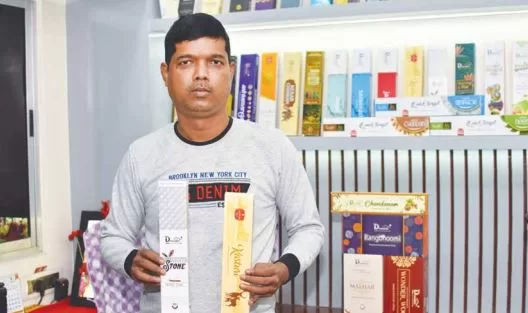
STRONG ECONOMY SEGMENT AND DEPOT MODEL DRIVING DHANLAXMI’S GROWTH IN EASTERN INDIA:RAM CHANDRA DHALAI
Paramita Enterprise, which manages the depot for Dhanlaxmi and Jai Ganesh brand in Kolkata, has played a key role in strengthening the company’s market presence across Eastern India over the last five years. In an interaction with Sugandh India, Mr. Ram Chandra Dhalai who manages the company depot spoke about the company’s decision to open a depot, advantages of the direct supply model, product trends, major markets in the state, and the changing dynamics of the agarbatti trade.
Sharing about the beginning of depot operations in Kolkata, Mr. Dhalai said that he manages the DhanlaxmiAgarbatti depot in Kolkata under the firm name Paramita Enterprise. The depot was established in 2020 and has now completed nearly five years of operations in the city.
Explaining why the company opted for a depot instead of relying only on distributors and super stockists, he said that Dhanlaxmi already had good sales in West Bengal. After discussions with the company’s Managing Director and Mr. Vinod Patel, it was felt that if uniform supply and faster service could be ensured, sales would further improve. According to him, opening the depot proved to be a major and successful step for the company in the region.
Mr. Dhalai explained that the biggest advantage of the depot model is the elimination of multiple layers of margins. In the conventional structure, margins are divided between super stockists and distributors, and freight costs are also added. With the depot system, goods are supplied directly to distributors, freight is managed centrally, and salesmen work within the same margin structure. This helps in better pricing and faster movement of products. He added that direct shop-to-shop servicing improves secondary sales, allows regular sampling, and helps the company receive immediate feedback from the retail market.
Speaking about product performance, he said that Dhanlaxmi has a very wide product range and continues to launch two to three new products or brands almost every month. Among all products, Aqua and Whitestone are currently the strongest-selling variants in the Kolkata and surrounding markets. These products mainly perform well in the economy segment, which dominates local demand.
He added that although the MRP of these products is around ₹70, they are commonly sold to consumers at around ₹50, making them suitable for price-sensitive buyers. According to him, box packing remains much stronger than zipper packing in West Bengal. While zipper packs are available and slowly growing, the economy box segment has traditionally been dominant and continues to lead sales.
On product diversification, Mr. Dhalai said that apart from agarbatti, the company is also focusing on expanding into other pooja-related products. Upcoming launches include pooja kits, camphor (kapoor), cup sambrani, and additional dhoop products, many of which are planned to be launched around exhibitions. Dhoop sticks in smaller sizes are already part of the product portfolio.
He further explained that the company operates under two brand names—Dhanlaxmi and Jai Ganesh—each under separate GST registrations. Jai Ganesh is the older brand, while Dhanlaxmi was introduced later with similar product ranges and price points.
Discussing distribution coverage, Mr. Dhalai said that the Kolkata depot supplies across entire West Bengal and also caters to Odisha, Jharkhand, and Guwahati (Assam). In West Bengal alone, the depot works with around 300 distributor parties, and each distributor typically services about 200 retail counters. In Odisha there are around 20 parties, in Jharkhand about 10, and in Guwahati around 3–4. He added that demand in West Bengal is so strong that sometimes it becomes difficult to supply additional volumes to neighboring states.
Highlighting major agarbatti markets in the state, he said that after Kolkata, strong demand comes from East and West Medinipur and East and West Bardhaman, including industrial belts like Asansol and Durgapur. In North Bengal, markets such as Siliguri, Malda, Murshidabad, and Berhampore contribute significantly to sales.
Commenting on the overall agarbatti market scenario, Mr. Dhalai described West Bengal as a very strong and stable market where companies with good planning and fieldwork can achieve monthly sales of several crores. He noted that while agarbatti continues to dominate with around 80% market share, dhoop products now account for nearly 20%, and this segment has grown significantly in recent years.
Addressing the perception that Bengal is only a market for cheap products, he said this is not entirely true. Premium products contribute nearly 20% of sales, especially during Durga Puja and festival seasons. Among price segments, the ₹50 segment holds the largest share at around 50%, while the lower price segments, including ₹10 and even ₹5 packs, together account for about 30% of the market.
Regarding exports, Mr. Dhalai said that small quantities are supplied to Bangladesh, mainly to Dhaka and Chittagong, around 5–10 times a month, depending on demand. Transport is usually arranged by buyers there, but pricing is extremely competitive, with square packs selling at around ₹5. He mentioned that brands like Parimal Mandir have a strong and consistent presence in the Bangladesh market.
Sharing his professional journey, Mr. Dhalai said that he has been in the agarbatti trade for over 22 years. Before managing the depot, he worked for nearly 15 years in a large agarbatti company in West Bengal, mainly in office and management roles. During the COVID period, he lost his job, after which he connected with Mr. Binod from Dhanlaxmi. Because of his strong distributor network and market experience, he was offered full responsibility to manage the West Bengal depot. He admitted that initially it involved risk, but with company support and consistent fieldwork, the operation gradually became successful.
Comparing manufacturing hubs, he said that earlier Bengaluru dominated the market, while Ahmedabad entered later and has grown steadily, especially in masala-based agarbatti. He added that earlier the trade functioned in a very informal way, relying mainly on bulk supply, but today the business has become system-driven, with organized marketing, field sales, and structured brand-building becoming essential.
On payment practices, Mr. Dhalai acknowledged that credit remains a challenge in the trade but said that his depot follows a disciplined system. Most transactions are either in advance or with a maximum of 15 days’ credit and, in rare cases, extended up to 21 days, but not beyond that.
Concluding the interaction, Mr. Dhalai said that success in today’s agarbatti market requires risk-taking, consistent effort, strong field presence, and reliable product support from the company, which together help brands grow even in highly competitive markets like West Bengal.


