


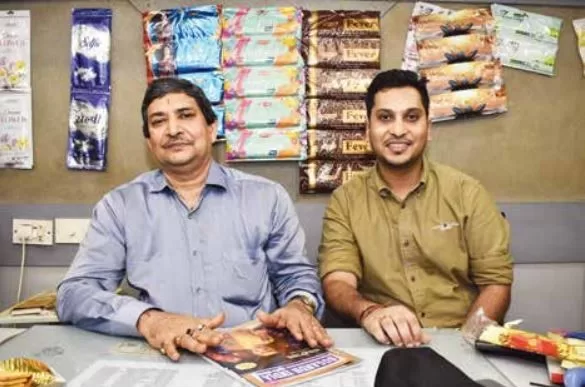

K.L. Bihani, who has been in the incense trading business in Kolkata for the last five decades, believes the incense trade is like the film industry: films release, some become superhits for a while and then fade away. Many films don’t do well and are quickly forgotten. Similarly, in the incense trade, many well-known brands enter the market; some fragrances become popular for a time, then either stabilize or disappear. Every product has its own life span. In this sense, no single company or brand holds a monopoly in the incense industry.
Jai Perfumery has been trading in West Bengal since 1970. Krishan Lal Bihani, the head of the firm, told Sugandh India that earlier he and his brother worked together; the brother moved to Bengaluru and is also in the incense business, while Krishan Lal continues to run operations locally.
Mr. Bihani said he has been in the incense business for 48 years and has seen many ups and downs. Their trade began by buying from local manufacturers and selling, but later he went to Bengaluru to expand, where he obtained agencies for Balaji and PradhanPerfumery. Within five years Balaji’s products took off and Pradhan’s Aawaz brand became a super hit, making him a distributor here. Over his journey, he also handled agencies for Cycle and several others. Today he distributes Denim from Shashi Industries, Pradhan, and Balaji’s Prashant brand. Other Balaji products are handled by others. He also represents A Ravi Rag, AKP’s Saba, SS Fragrance, and Misbah.
He prefers not to take too many agencies — he works with a limited number of companies. He told Sugandh India that his network covers almost all of West Bengal and that he also supplies to Bangladesh.
Mr. Bihani noted that the industry has changed a lot. Earlier, one distributor or agency based in Kolkata would often handle the entire state; now companies have set up centers in other towns. Siliguri has become the North Bengal center while South Bengal remains centered around Kolkata. When business first began, Kolkata supplied Bihar, Assam, and Odisha, but now companies have established their own distributors and depots across regions. He said supply to Bangladesh hascontinued for twenty years; brands like Parimal Mandir’s Gurudev are very popular there. Cycle, Darshan, and other brands also reach Bangladesh, and Shashi’s Denim is exported from here.
Mr. Bihani said quality demand in Kolkata has decreased somewhat and people prefer quantity — which is why local products (economy-range) sell well. He explained that a ₹20 pouch here often contains 70–80 grams and economy products might contain 80–100 grams. ₹10 packs are now rare.
Among the top-selling products here are Forest, Karnataka Fragrance, Balaji, and Cycle. But no single company has a monopoly. The dry-stick market is still nascent and growing; incense will continue to sell as well. Over the last ten years, demand for dhoop has risen slightly and wet dhoop is also present. Incense sticks still control about 80% while bambooless products make roughly 20% of the market; within bamboo-less, dry-stick and dhoop split nearly 50–50.
In wet dhoop, besides Rocket and Zed Black, Devdarshan, Hari Darshan, and local products sell. Cycle’s Naivedya for sambrani once had strong demand and still sells, though other companies’ sambrani sticks and cups have entered the market. In South Bengal, loose camphor dominates; many sellers bring it, pack it themselves and sell.
Sandal tika, prayer oil, diya wicks, etc., sell mainly in shops that specialize in puja items; packaged puja material is not common here. He said the market keeps changing: customers want quantity and some new fragrances last for a time, while a few perfumes have endured for many years — for example, the green champa from Pushpa that sold decades ago still sells today.
Venue : Mumbai
Date 12th and 13th April 2025


