


Local Manufacturers Control70% of Nashik Market: Manoj Agrawal
In the religious city of Nashik, the incense and dhoop (resin incense) business isdominated by local manufacturers. Manoj Agrawal, head of Goyal PerfumeryWorks,told Sugandh India in an interview that in terms of quality, price, and supply, localmanufacturers of Nashik perform much better. This is the reason why 70% of theincense and dhoop market here is controlled by local producers. Among them,Nandini, Suchde, and his own Goyal brand offer far superior quality and lower-pricedproducts compared to branded companies. In response to a question, he said thatlocal manufacturers are active in all forms of packaging—loose bundles (muthha),boxes, and zipper packs. However, in Nashik, loose bundle packaging sells the most.
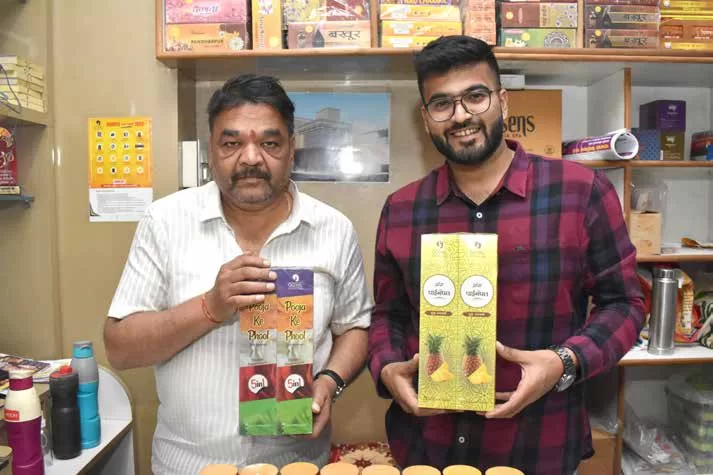
Goyal Perfumery Workshas been working inthe incense industrysince 1956 andmanufactures under the Goyalbrand. In addition, they are alsolocal distributors for brandedcompanies such as Zed Blackand Devdarshan. Thus, frommanufacturing to trading toretailing, Goyal Perfumery is amajor name.
In the conversation withSugandh India, Manoj Agrawalexplained that his grandfatherstarted this business in 1956, andhe himself is the third generation,while the fourth generationShubham Agrawal—has alreadybegun handling marketing. Heshared an interesting story abouthow the family entered the incensetrade. His grandfather used to runa grocery store at Gangaram Ghat,wherelarge numbers of pilgrimsand tourists visited. A knownacquaintance who was an incensehawker suggested that they stockincense from a Karnataka-basedcompany, and he would sell it. Atthat time, incense products fromKarnataka dominated the market.The company sent the stock, butthe acquaintance never showed updespite repeated reminders.Eventually, the goods lay unsoldfor months. Then, when hisgrandfather asked his wholesalesupplier for groceries if they couldsell it, the entire stock sold withina week. Orders were placed again,and thus incense from Karnatakabegan arriving regularly. Later,other companies’ products alsocame in, and eventually, rawincense manufacturers also beganapproaching them. This is howthey entered the trading business.
Manoj Agrawal recalled that inthose days, only two or threeproducts were available. Ascompetition grew, their firstagency was for Champa incensefrom Belgaum in red packs.Gradually, many big companiesfrom Bangalore gave thembusiness, and trading expandedsignificantly. Later, they beganmanufacturing themselves, butmeeting Nashik’s specific demandwas difficult. Hence, theyeventually reduced dealings withmany companies and now focus ondistributing only two or three. Forexample, they trade MeeraPerfumery products fromUlhasnagar and SaraswatiCamphor’s 3 Pine brand. Theirdistribution network covers morethan 2,000 counters across Nashikdistrict.
Under the Goyal brand, theystarted their own manufacturing.He said that the ₹10 packcontaining 25 sticks is verypopular, but only their brand andNandini hold a major share in thissegment. He emphasized thatacross India, no company providessuch affordable incense with bothgood quality and quantity.Although Zed Black, Moksh,Nandini’s Prem Ras, and severaloutside products sell here, theyonly make up 30% of the market.Local brands—such as Nandini,Suchde, Goyal, and four othershold 70% of the market.
In response to anotherquestion, he said that largebranded companies from outsidestruggle a lot in the Nashikmarket. The biggest reason is theheavy reliance on credit sales.Payments here are cleared in 6months to a year, somethingoutside companies are unwilling toaccept. His own payments alsorange from a minimum of onemonth to a maximum of a year. Heexplained that packaging pricedbetween ₹50 and ₹100 (bundles,zipper packs, and boxes) sells wellhere, while products priced at ₹10MRP are rapidly declining.Retailers here earn good margins,while wholesalers work on verylow commissions. There is also apremium market wherepacks of₹100 (10 sticks or half-kilo packs)sell. Premium brands from Balajiand companies from Gujarat alsohave a presence. Almost everyother day, a new company tries toenter the market, but not allsurvive. Among outside brands,Zed Black, Moksh, Ullas, Balaji,Dhoop-Chaon, Forest, and Cycledo well, but branded companies’share remains only 30%.
On the growing zippersegment, Manoj Agrawal sharedthat ₹440 and ₹220 packs areselling rapidly. He said a majorproblem in the industry is pricecompetition, which forcescompromises in quality andquantity. “We don’t want to uselow-quality raw materials, but wehave to because customersdemand lower prices,” headmitted.
He added that in Nashik, thedhoop market is growingcompared to incense. Currently,incense makes up 70% whiledhoop is 30%. Within dhoop, bothdry and wet types have about50–50 share. The introduction ofSambrani Cups has reduceddemand for products like lobanpowder. In wet dhoop, Manthansells the best, followed by Safalfrom Nagpur, Devdarshan, andMeera Perfumery. MeeraPerfumery from Ulhasnagar sells200g packs, while most othercompanies offer only 100–120g. InSambrani cups, Anubhav, Delta,and GT are popular, with GT beingthe pioneer in cups.
On another question, ManojAgrawal explained that the incenseindustry cannot be like FMCG. Itsmarket depends on retailers’ trust.However, now the new generation,better educated, is entering thetrade, and they are expected tobring improvements. Until now,most people in this industry werenot highly educated, usually onlycompleting 10th or 12th grade. Butwith well-educated youth handlingthe business differently, the futurewill improve. He said the incensebusiness depends heavily on thestrength of marketing and salesteams, which ultimately decidesthe success of a product.
Speaking about camphor, hementioned that Nandini andMangalam sell the most, followedby 3 Pine and Orkay. At their retailcounters, the average monthlypurchase of incense and pujamaterials per customer is about₹300. Interestingly, 8 out of 10customers do not ask for specificbrands; they simply requestincense. Only in supermarkets orsimilar outlets do customersdemand branded products. Underthe Goyal brand, incense and drydhoop are available from ₹10 up to₹350 per bundle, though productspriced at ₹60–65 are the mostpopular. Their distributionextends as far as Trimbakeshwarand Shirdi. He concluded bysaying that in the family, thefourth generationShubhamAgrawalhandles marketing,while he himself looks afterproduction and quality.


