



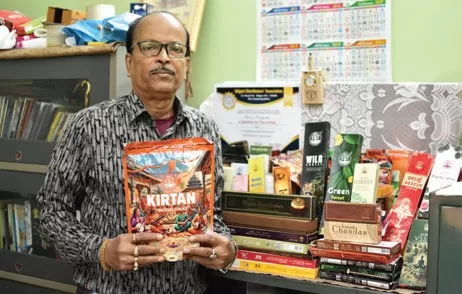
Agarbatti trading is a stable and profitable business: Tarun Mukherjee
The Siliguri agarbatti market of West Bengal is a major hub of North Bengal, from where agarbatti products are supplied to Assam, the Bhutan border, and Sikkim. Mr. Tarun Mukherjee, head of Loknath Trading, told Sugandh India in a conversation that he has been engaged in trading, super stockist, and C&F work of agarbatti products since 1988. As a super stockist, he oversees the entire North Bengal market. He said that his supply network extends from Malda to the Assam border and up to Sikkim and Darjeeling. He handles the work of Forest Fragrance, Bengaluru, across all these areas, and it is a rapidly growing brand. He said that basically he is in FMCG product trading. He deals in dry fruits, KitKat, Raja Khaini, Hindustan Unilever, and Nestlé, but now he is focusing on the agarbatti trade. He said that the main reason for this is that agarbatti is a product that generally does not have an expiry date. Therefore, it is a profitable business, and every person buys agarbatti every month, whereas in FMCG products, some items can be postponed for a month, but for pooja rituals, a few packs of agarbatti are always purchased.
On Sugandh India’s question about what kind of market Siliguri is for agarbatti, he replied that North Bengal starts from Farakka and includes Malda, Raiganj, Balurghat, Islampur, Dalkhola, Cooch Behar, Darjeeling, Jalpaiguri, Kalimpong, Uttar Dinajpur, Dakshin Dinajpur, Alipurdwar, and Kamakhyaguri up to the Bhutan border. Apart from this, in Sikkim, markets from Jorethang, North Sikkim, South Sikkim, and Gangtok are operated from Siliguri. He has distributors across all these places. In response to a question, he said that the Kolkata market is completely different. Compared to North Bengal, cheaper products also sell in South Bengal. Kolkata has a population of about 12–13 crore. There, Hexa also sells ₹10 and ₹5 products, whereas in Siliguri, the minimum pack sold is ₹20. In town areas, zipper packs from 100 grams to 500 grams also sell. In box packs, eco or zipper packs priced at ₹20–30 sell. During the festive season, bamboo-less products sell well, including wet dhoop, dry sticks, and cones.
Tarun ji told Sugandh India that the trend in Sikkim is towards premium products. People there buy zipper packs with more sticks. People living in hilly areas purchase three to four zipper packs in a month so that they last for one to two months. For them, coming down from the hills to the market is difficult. He said that along with zippers, eco-packs also have a good market. In Darjeeling and Kalimpong, zippers sell more. In Gangtok and smaller towns, both zippers and eco-friendly products sell. In response to a question, he said that in rural areas of North Bengal, ₹5 and ₹10 packs do sell, but in urban areas, people prefer good fragrance and good quality. Although the premium market is not very large, packs priced up to ₹1100 are also sold. Such customers are more in Gangtok, Siliguri, and Cooch Behar.
Replying to a question about the best-selling brands here, he said that Zed Black, Moksh, Rocket, Cycle, Forest, Balaji, and ITC sell the most. He said that Zed Black has a monopoly here, and now Forest is also being liked by a large number of people. He said that Forest has three to four top-selling products, including white agarbatti and black agarbatti in zipper and eco packs. The ₹10 pack has higher volume. Packs priced between ₹10 and ₹50 and ₹80 MRP also sell well. Its kirtan is very popular. In Kirtan, there is a ₹30 pouch containing 75–80 sticks. Similarly, Shalimar’s Avida is also a hit product. Forest’s ₹20 box and Kirtan’s ₹30 pouch and ₹20 box packs are well liked.
In response to a question from Sugandh India, he said that in the dhoop market, bamboo-less products have grown, and the Marwari segment prefers them more. Still, agarbatti accounts for 85 to 90% of sales, while dhoop has a 10 to 15% market share. He said that earlier people here were not even aware of wet dhup. Now they have started knowing it, and now wet dhoop is selling more. In hilly and urban areas, the bamboo-less market is growing. In wet dhoop, Zed Black’s Manthan, Rocket, Forest, Cycle, and Moksh sell well. Similarly, in sambrani cups, GT Chennai is number one. Cycle’s Naivedya also sells a lot. There is also a market for camphor here, where Zed Black and Cycle sell. Zed Black’s scented agarbatti is doing well. He said that in Siliguri, most of the market is wholesale counters, like a mandi. From here, supplies are made to general stores and paan shops across North Bengal. The economy range ₹5 pack of agarbattis sells around temples and religious places. In response to a question, he said that a customer here usually purchases around ₹200 per month, and out of 10 customers, 4 buy based on brand name.


