


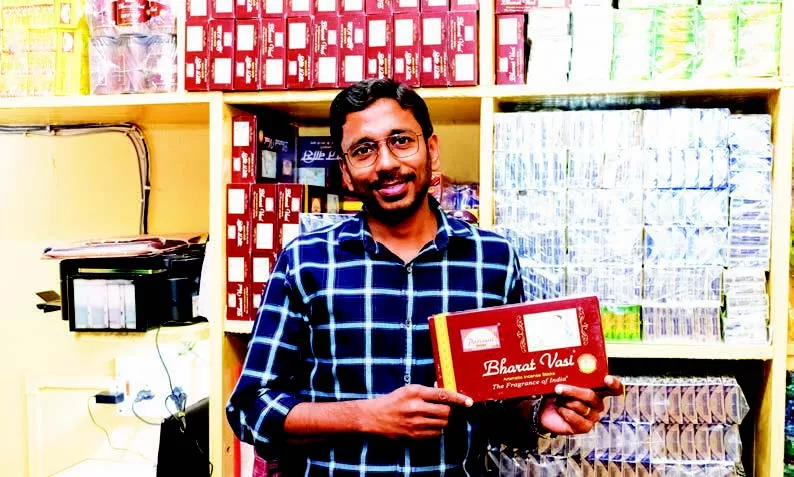

Bengaluru-based agarbatti companies continue to dominate the major cities of Assam and the North East. From economy to premium-range products, consumers in the region prefer Bengaluru brands the most. Speaking with Sugandh India, Manish Agrawal, head of Gayatri Store in Guwahati, said that although Bengaluru companies still hold a strong position in the market, several Ahmedabad-based companies have also been aggressively strengthening their presence in recent times.
Gayatri Store has been active in the agarbatti business for the past 12–13 years. Replying to a question, he said that they are super stockists for Parimal Mandir. Although they also deal in bakery products, papad, and other categories, his journey in the agarbatti business has been long and full of struggle. He said that he started his business journey with Madhukunj Agarbatti in Bhubaneswar. Later, through one of his contacts, he visited Bengaluru and met companies such as Padma and Vijayalakshmi. During that visit, he came to know that he should meet Mr. Jagannath in Kanakapura. At that time, Mr. Jagannath entrusted him with the trading business of the newly launched Uma brand. He worked on the brand for nearly a year and achieved record sales.
He told Sugandh India that initially he worked as a trader for the company, but later he was appointed a super stockist. Today, his network extends across Assam and Tripura. Supplies are being managed through nearly 130 distributors across these regions. Replying to another question, he said that no single brand of any company performs equally across an entire state, as consumer preferences for fragrance and product range vary from region to region. Brands such as Gurudev, Bharatwasi, Moment, and Shubh Labh from Parimal Mandir perform very well in the market. In particular, products priced at ₹20 and ₹60 MRP under the Shubh Labh range enjoy very high sales.
He further explained that earlier, ₹10 MRP box packs were the most popular products in the region. Although they still sell, the demand for ₹20 and ₹30 box packs has increased rapidly. Similarly, ₹5 products are now witnessing very limited demand. Such products are mainly manufactured by local producers and sell mostly in rural areas or around temples. According to him, local manufacturers do create some level of competition for branded companies because their production costs are significantly lower.
Manish Agrawal said that Guwahati is a strong market for medium-range products, while local brands also perform well in the economy segment. He added that his competition comes from brands such as Moksh, Cycle, Ganga Products, Zed Black, Darshan, and ITC. ITC’s Anushree brand has grown rapidly over the past one or two years. According to him, ITC benefits from its strong network of general stores and kirana shops, which helps its agarbatti products achieve strong sales.
Replying to a question, he said that the market share for wet dhoop and bamboo-less products in the region is currently around 5%, with both categories witnessing almost equal demand. In the dhoop category, Hari Darshan performs well. The sambrani cup market is also gradually expanding, and the category initially gained popularity through Cycle’s Naivedya Cup. In the cup segment, Zed Black and Forest Bahubali are also performing strongly.
He further told Sugandh India that both strong and light fragrances are preferred in the region, although sandalwood and rose fragrances remain the most popular. He added that the market for agarbatti box packs priced at ₹50–₹60 MRP is growing rapidly in the region.
Venue : Mumbai
Date 12th and 13th April 2025


