


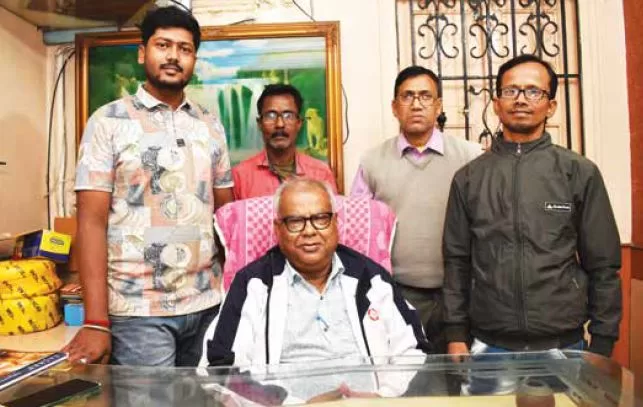

Mr. Ujjwal Bhadra, who has been in the agarbatti business for 47 years in Malda, West Bengal, believes that the biggest challenge in the industry today is credit. In an exclusive conversation with Sugandh India, he said that while established, quality brands continue to sell well, many companies push excess stock onto distributors and wholesalers by offering higher schemes and margins.
He explained that selling agarbatti is relatively easy, as retailers readily stock products on credit—but recovering payments is difficult. This is why most large companies have now started supplying goods on an advance basis. A distributor cannot afford to block their capital for one or two months. Due to credit-related losses, many newcomers in the trade are forced to exit the business within a year or two. He emphasized that all companies should seriously consider this issue for the betterment of the industry. Operating through UjjwalBhadra Enterprises, he shared that he deals in products from Bengaluru companies, including Padmini, Darshan International, Balaji, Ashoka Trading, Purnima, Ashika, Ullas, and Big Bell.
On supply and distribution, he said that most goods arrive via truck, which is then supplied to regions like Islampur, Dalkhola, Balurghat, Berhampur, Malda, and Raiganj. He described the Malda market as strong, with local production of agarbatti (referred to as “kacchi agarbatti”) taking place in areas like Khairatipara, Mangalwadi, and Ghoshpara. These are supplied across West Bengal, Bihar, and Jharkhand, although he himself is not involved in that segment.
He noted that products from Bengaluru dominate the Malda market, along with demand for brands from other states.
Speaking on taxation, he pointed out that agarbatti was earlier tax-free. When GST was introduced, the government had indicated that puja and havana materials would be exempt, but agarbatti—despite being a puja product—was taxed at 5%. He believes this needs reconsideration.
Regarding consumer preferences, he hesaid that people in Malda prefer mild, floral fragrances such as rajnigandha, bela, rose, and sandalwood. Popular brands in the region include BharatDarshan, Balaji, ITC, Zed Black, and Cycle. Among his own sales, Balaji, Bharat Darshan, and Darshan International perform the best. Forest and Koyas also have a presence, along with products from companies offering higher credit and profit margins.
He mentioned that Balaji products priced at ₹20 and ₹40 sell well, and there is demand for 100-stick packs priced at ₹30. Lower-priced products (₹5 and ₹10 MRP) are gradually declining, although some still sell under brands like ITC, Zed Black, Bansuri, etc. He added that the market caters to all segments of society, so a wide price range continues to exist.
There is also growing demand for jumbo packs (400–500 grams) priced at ₹325, ₹375, and ₹425. In Malda, agarbatti accounts for about 95% of the market, while dhoop holds only 5%. Demand for white agarbatti is rising rapidly. Bamboo-less wet dhoop has limited demand, while dry products are more popular.
He observed that companies with strong agarbatti sales also tend to perform well in dhoop. In wet dhoop, Balaji’s Mata Rani, Rajnigandha, Kasturi, Sandal, and Rose variants are popular, along with Darshan’s Maharaja and Guggal. After Balaji, Manthan is also performing well, with Rocket and ITC present in the market too.
He added that camphor and dhuna have strong demand, with brands like Cycle and Hari Darshan leading. Sambrani cups are also popular, especially from Cycle, Balaji, Darshan, and Zed Black. However, sandalwood tika does not have much demand in this region. Finally, he noted that an average customer in Malda spends ₹100–150 per month on agarbatti, and in urban areas, about 30–40% of customers make purchases based on brand names.
Venue : Mumbai
Date 12th and 13th April 2025


