



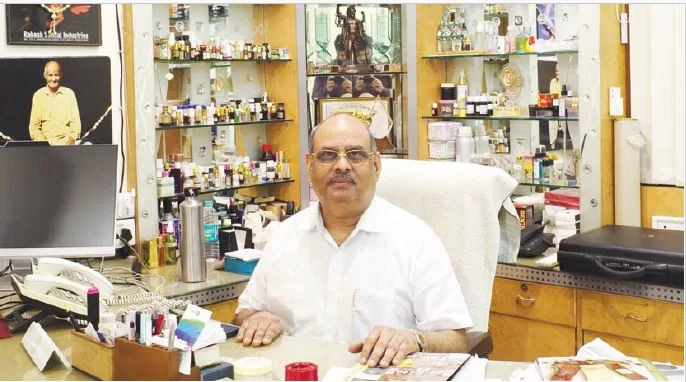
India can emerge as a global hub for the fragrance industry: Yogesh Dubey
Rakesh Sandal Industries’ fragrance footprint spans across the world
India possesses an immense reservoir of medicinal plants, aromatic herbs, flora, fruits, flowers, and trees essential for human health. Not only this, vast forests in Sri Lanka, Indonesia, Vietnam, Nepal, Myanmar, Bhutan, and Guatemala also hold large reserves of medicinal and aromatic vegetation, which Indian businesses are utilizing. In such a scenario, by combining new research and traditional Indian knowledge to produce international-standard natural oils and perfumes as required, India can dominate the global fragrance industry. Chairman of Rakesh Sandal Industries, four-time President of the Essential Oil Association of India (EOAI), currently President of the Fragrance & Flavor Association of India (FAFAI), and an active member of the Bureau of Indian Standards, Mr. Yogesh Dubey shared this information in a special conversation with Sugandh India.
Responding to a question, Mr. Yogesh Dubey explained that international standards regarding natural fragrances and oils differ in many aspects from traditional Indian usage. For example, Tulsi has long been widely used in India for worship, food, and medicinal purposes. However, at the international level, limits have been set on the quantity of use of certain natural components from a safety perspective. He said that many natural oils are derived from Indian vegetation and are traditionally considered suitable for our climate and usage; however, in international standards, they are evaluated based on their chemical components and long-term usage.
He further explained that Indian standards are now being developed keeping this balance in mind so that, on one hand, the quality and heritage of traditional natural medicinal and aromatic oils can be preserved, and on the other hand, compliance with global safety standards can also be ensured.
In a conversation with Sugandh India, Mr. Yogesh Dubey said that Rakesh Sandal Industries was established in 1970 by his father Mr. Ramchandra Dubey. He is now 86 years old but still visits the factory daily, and under his guidance and protection, we all work. He said that before entering the fragrance industry, they had 4-5 rice mills and 5-7 brick kilns. All of these were handled by his father. He added that their residence and business were located behind IIT Kanpur, and even now a significant part of their operations remains there.
He said that he started working in 1980, and then the business kept expanding. Around 1990, the natural aromatic and medicinal oil business began spreading in the international market. However, even before that, his father used to travel to Gulf countries as well as Japan, Bangladesh, Singapore, Malaysia, and Thailand and supply their products there. Then his father advised him to focus on the international market, and thus he started taking products to European countries and the American market. During this period, he joined the Essential Oil Association of India (EOAI) and then organized the industry’s first seminar in 2003 at Hotel Taj in Lucknow, Uttar Pradesh. In 2006, under his leadership, a four-day mega show was organized in Kannauj and Kanpur. In this way, he remained continuously active. He said that in the 70-year history of the organization, he was the only person who served as president four times. Later, an amendment was made, and now any individual can serve only twice as president. At present, he is also the president of FAFAI. Along with being the only FAFAI President from Uttar Pradesh, he is also the only person in India who has been President of both associations.
Rakesh Sandal Industries has been present in the international market since 1990 and exports mainly to Argentina, Brazil, Paraguay, the US, Mexico, several European countries, Canada, Cambodia, and more than 46 countries. Due to its export products and quality, the company has received the highest number of export awards in the industry.
He told Sugandh India that his company primarily supplies natural oils to the pharma, cosmetic, and fragrance industries in the essential oil segment. He said that their lab is very modern and large, producing spices and natural essential oils according to international standards. The pharma industry requires very high-quality products, which are also manufactured there. In this way, they have more than 7000 customers worldwide. In addition, many companies in India also procure material from them.
Answering a question, he said that recently the Bureau of Indian Standards has set standards. Earlier, these did not exist. Previously, people used to produce and sell anything, for example, claiming their product to be herbal, but now many things have improved. He said that just as the pan masala industry faced major challenges due to a perception that it uses chemicals, similarly, the agarbatti industry has also faced challenges. He explained that he is also part of the managing committee of the Bureau of Indian Standards, where quality and safety standards for agarbatti are being defined. In this way, only by improving product quality can we establish our identity globally.
FAFAI President Mr. Yogesh Dubey said that the essential oil production in Kannauj is still largely based on old standards, but now new standards are being developed. These standards are being created by integrating research and labs of FFDC, CIMAP, IIIT Jammu, and Palampur, along with several leading companies of the fragrance industry. Work is being done in collaboration with experts from the government and companies. He mentioned that 25 of his products are also part of this process.
Responding to Sugandh India’s question about trends in the country’s essential oil market, he said that there are many fruits, flowers, trees and plants on which sufficient research has not yet been done. Now, in collaboration with the government, work has begun towards identifying and researching their usage. He said that the importance of natural oils will always remain and India will lead in this. For example, Indian sandalwood oil is considered very important in the perfume industry, as it enhances the quality of other fragrances when blended with them.
Responding to a question regarding the impact of the America–Israel and Iran wars on the industry, he said that a large part of the industry’s business operates through the Gulf route. Due to disruption in air and sea routes, the supply chain has been affected. Limited flights are operating from Dubai, and fares have increased significantly. Courier costs have also risen, and due to reduced tourism in Gulf countries, market conditions have weakened. Flight prices to Europe have also increased considerably. A fragrance conference, IFEAT, scheduled in Abu Dhabi, has been shifted to Bangkok.
Answering a question about the company’s future plans, Yogesh Ji said that his family is now actively involved in the business. His nephew Gaurang Dubey and elder sons Kartikeya Dubey and Kaushal Dubey have become key pillars of the business. His daughter-in-law Purva Dubey is also associated with the perfume industry and is contributing. He said that earlier his focus was more on B2B, but now they are also developing their consumer brand.
He said that people associated with this business must adapt themselves according to changing times. The demand for Indian products is increasing worldwide, and we have a traditional advantage in this sector. We have sufficient availability of raw materials and also procure raw materials from countries like Sri Lanka, Nepal, Bhutan, Myanmar, and Vietnam. Therefore, we should focus more on high-quality natural oils and other products.
Responding to a question regarding issues related to sandalwood, he said that recently a seminar of the Essential Oil Association of India was held in Mumbai, where DGFT, Customs, Chemexcil, and several government representatives and industry members participated. Detailed discussions were held on sandalwood policy. He said that earlier sandalwood oil used to come from Australia, but now the situation is changing. Large quantities of wood are being exported and processed abroad, due to which the benefit of value addition goes outside. He suggested that the government should establish clear guidelines and a legal framework on sandalwood policy.
He mentioned that under the government of Prime Minister Narendra Modi, the Aroma Mission has been launched, with an annual budget of around ₹100 crore. It includes CSIR and its institutions such as CSIR-CIMAP and IIIM Jammu. One of its major achievements is the development of agarwood (oudh) from the northeast. However, its export is
regulated and takes place under a licensing process; therefore, improvements are needed.
Responding to a question regarding new research in the fragrance industry, he said that work is also being done on determining safe usage levels (dosage) of perfumes and oils. Along with this, emerging areas like aromatherapy are also being focused upon.


