



Innovative Products Become Successful Brands: Chandresh Somaiya
Across the country, thousands of companies manufacture agarbatti and dhoop. At the same time, millions of products are sold across a country of 1.5 billion people. Yet, every year, a large number of new agarbatti companies enter the market, and some eventually gain popularity and develop into established brands. Mr. Chandresh Somaiya, head of Manhar Sales Corporation, a company involved in agarbatti trading in Gujarat since 1976, told Sugandh India in a conversation that new companies face difficulty establishing their products as popular brands. However, if its products offer strong quality, new fragrances, innovative packaging styles and reasonable pricing compared with competing products, they can establish their place in the market and continue climbing the ladder of success.
Elaborating further, Mr. Chandresh said that suppliers like them also promote new brands that offer lower prices along with good-quality products. Sampling products among retailers and customers is essential for any new company. He said that traditional perfumes and fragrances are already very popular in the market. Simply repeating the same fragrances makes it difficult for a new company to establish itself. However, if companies innovate their products through research and development, their chances of success increase significantly. Fruity notes are a good example. When Pineapple and Jasmine fragrances were introduced, they became so popular that today almost every company makes products with fruit and jasmine fragrances. Similarly, introducing innovation in packaging helps a product stand out at the retail counter and attracts customers. If its price is lower than competing products, customers are likely to pick it up, and if the quality is good after use, they return to purchase chase it again.
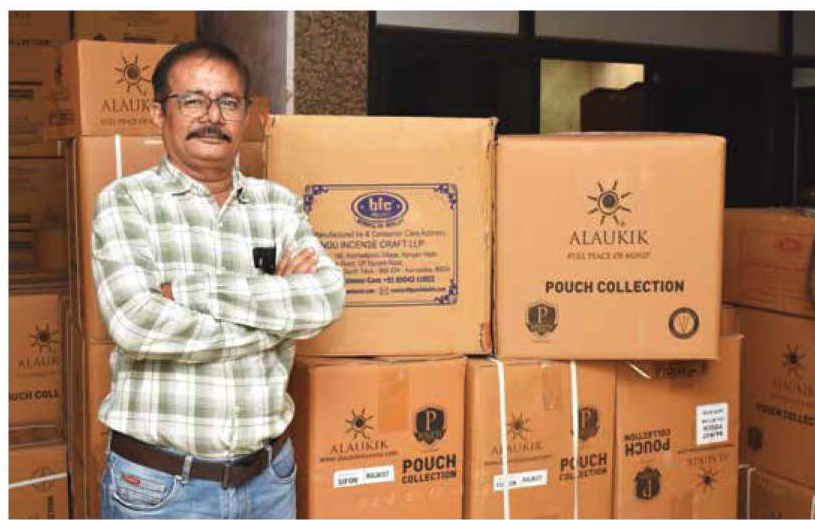
Mr Chandresh told Sugandh India that his family has been involved in the agarbatti business for 50 years under the name Manhar Sales Agency. Five years ago, they expanded the business by starting operations under the name Manhar Sales Corporation in Rajkot. He explained that, apart from Rajkot, the firm handles Alaukik across Gujarat and Rajasthan. It also handles Shreeji Agarbatti Works of Vadodara for Gujarat and Rajasthan. In addition, they have been handling the distribution of Bengaluru-based BIC for the past one year. They also handle Shree Bhawani Agarbatti Works of Morbi. Besides these, they handle Sarathi from Bengaluru and several other companies across Gujarat. He said that their supply network includes more than 100 distributors. Answering a question about how they manage business from Rajkot to- Rajasthan, he said that many large companies do not have depots in Rajasthan. Building and operating depots for every company is difficult; therefore, these companies have entrusted them with the business there. Their supply network primarily covers 10-12 major cities, including Jaipur, Ajmer, Banswara, Sirohi and Udaipur.
On being asked by Sugandh India why he chose Rajkot as his headquarters instead of Ahmedabad, Mr Chandresh explained that Rajkot, like Ahmedabad, is well connected. There is not much difference between the markets of Ahmedabad and Rajkot. Although Ahmedabad has many very large traders, Rajkot has also been a centre of the agarbatti trade for the past 50 years. Therefore, from a business perspective, there is no major difference between Ahmedabad and Rajkot.
Answering another question, he said that Gujarat is divided into four regions: North Gujarat, South Gujarat, Saurashtra and Kutch. Kutch includes places such as Jhanzhar, Katarna, Mandvi, Gandhidham and Adipur. Surat, Vapi and Valsad fall under South Gujarat. Ahmedabad is the capital of Gujarat and also a major business centre. Although products with different prices, ranges and trends are popular across these regions, products priced at ₹70, ₹150, ₹35 and ₹15 generally sell across the state. He explained that every brand has its own market, while some brands have a dominant position in certain areas. For example, Alaukik’s Pineapple and Musk Melon fragrances are among the top-selling products. Natural products are also popular here. In the natural segment, Shreeji’s wet dhoop is particularly strong. BIC’s Panchvati and Shivam are products known to almost every consumer. Similarly, Bhawani is a very old brand. Shreeji’s Wari brand performs well in both pouch and box packaging.
When Sugandh India asked what makes a product perform well in the market, he said that along with quality, companies also need to offer marketing schemes. Most companies offer schemes during the festive season. However, schemes are no longer running throughout the year because raw-material prices have increased significantly due to the war, putting companies under financial pressure. At the same time, they are unable to increase the prices of their products. Answering another question, he said that the Rajkot market is very good, and several large companies also manufacture here. In this way, Rajkot is gradually emerging as a centre of the agarbatti industry.
Answering another question, Mr Chandresh said that products from local brands as well as brands from other states sell strongly in the market here. However, brands from other states face difficulties because their transportation costs become very high. In comparison, products manufactured in Ahmedabad, Rajkot and other districts of Gujarat not only offer good quality but are also available at lower prices. Local manufacturers can deliver good products on time. Outside companies are generally able to compete here only when they reduce their margins and supply products at lower prices. Companies from other states mostly bear the transportation costs themselves, which enables traders here to purchase their products. He explained that raw-material prices are continuing to rise, creating pressure on companies over price increases. Although the war has affected industries in one way or another, agarbatti is a business where prices cannot be increased every day. Once prices are increased, another increase can generally be made only after six months or a year. This is why many companies have reduced the weight of their product packs. Customers also do not pay much attention to the weight or number of sticks; their primary focus remains on price and quality.


