

The Agarbatti Industry Is Expanding into Pooja Products: Alok Mundra
Due to rapidly rising inflation, increasing raw material prices and higher transportation costs, the profit margins of agarbatti and dhoop traders, manufacturers, distributors and retailers are steadily declining. This is why, over the past few years, businesses dealing in agarbatti and dhoop products have also started manufacturing and trading pooja materials. In a conversation with Sugandh India, Mr Alok Mundra, head of Indore-based Thakur Ji Trading Company, said that the agarbatti and dhoop industry has not declined. The market is growing, but the volume that previously belonged to agarbatti now also includes wet dhoop, dry sticks, sambrani cups and cones because of the growing preference to avoid burning bamboo. As a result, dhoop products have gained a greater share of the overall agarbatti market. Answering a question, he explained that major agarbatti and dhoop manufacturers with pan-India brands have also started producing other pooja products, such as camphor, Chandan Tika, pooja oil, desi ghee and havan samagri. Consequently, agarbatti traders, distributors, agency holders and retail shop owners have also started stocking the companies’ entire product ranges. Today, dozens of shops exclusively selling different types of pooja materials alongside agarbatti and dhoop have opened in cities across the country.
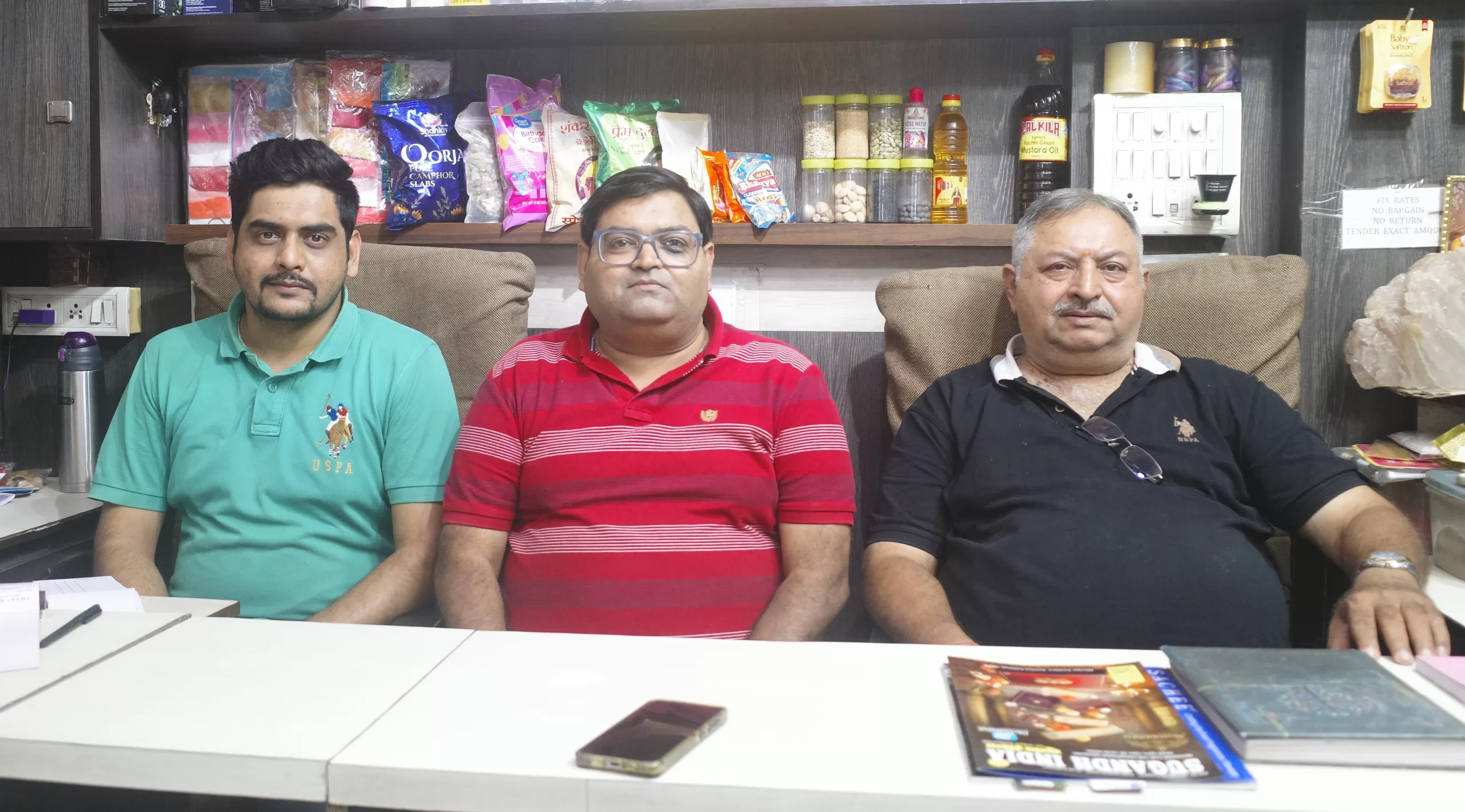
In response to a question from Sugandh India, Mr Alok Mundra, head of Thakur Ji Trading Company, explained that he started his agarbatti business in Indore. His son Mridul and younger brother Anoop also assist him in the business. He said that when he entered the trade, handmade agarbattis were prevalent and Bengaluru dominated the industry. When agarbattis began to be manufactured using machines in villages and households across the country, Bengaluru’s monopoly over agarbatti production came to an end. Thakur Ji Trading Company holds agencies for Bengaluru-based brands such as Savitri Sugandhalaya, Omega Incense and A Ravirag. Besides these, they stock all the brands that customers request at their retail counter.
In response to a question from Sugandh India, Mr Alok said that the prices of raw materials and packaging materials used in agarbatti manufacturing, along with transportation costs, have risen considerably. Consequently, everyone from manufacturers to retailers is facing difficulties. Some companies have reduced product weights and increased prices, but most manufacturers have been unable to reach a consensus on this because of competition and a lack of unity. As a result, profit margins are steadily shrinking. He explained that Indore is a very good market for agarbatti and dhoop. However, payments come in very slowly because credit sales are common here. The market for premium products is also relatively small. Answering a question about marketing, he said that the market presents several other challenges. Every distributor wants to capture as much of the market as possible through salespeople. Competition is intense, making it difficult even to recover the expenses of employing salespeople. This is why they have reduced their own marketing activities.
In response to another question from Sugandh India, he explained that both agarbatti and dhoop are widely used here. Due to concerns about burning bamboo, the use of wet dhoop, dry sticks, cones and cups is growing rapidly, while agarbatti’s share of the market is declining. They, too, have started stocking all types of pooja materials at their retail counter alongside agarbattis. Answering a question, he said that packs with MRPs of ₹10, ₹20, ₹50 and ₹100 sell the most here, but ₹50 zipper packs are particularly in demand. He explained that brands such as Nishan, Shreeji, Devdarshan, Darshan International and Black Stone have varying levels of market presence. He said that whenever a customer buys a particular product once, they usually ask for something better or newer on their next visit. This is why dozens of brands are available in the market, and customers keep trying different ones.
When asked about his expectations for the market during the festive season, Mr Alok Mundra said that business was progressing reasonably well. Companies offer schemes during festivals, but nowadays some promotional scheme or another runs throughout the year. Target-based schemes are also available. He said that wet dhoop has a good market here, but agarbatti still sells more. Kashi is the leading brand in dhoop. Delhi-based Grah Shanti also performs well at their store and receives repeat orders. He explained that Saraswati is the best-selling brand in camphor, followed by Kashi Ashtgandh and Mangalam. In Chandan Tika, Kashi ranks first, followed by Labh Ganga, Manohar and Hari Darshan. Pooja oil and desi ghee also have a market, but there is no particularly dominant brand in these categories. Packaged products from local manufacturers sell the most.


